
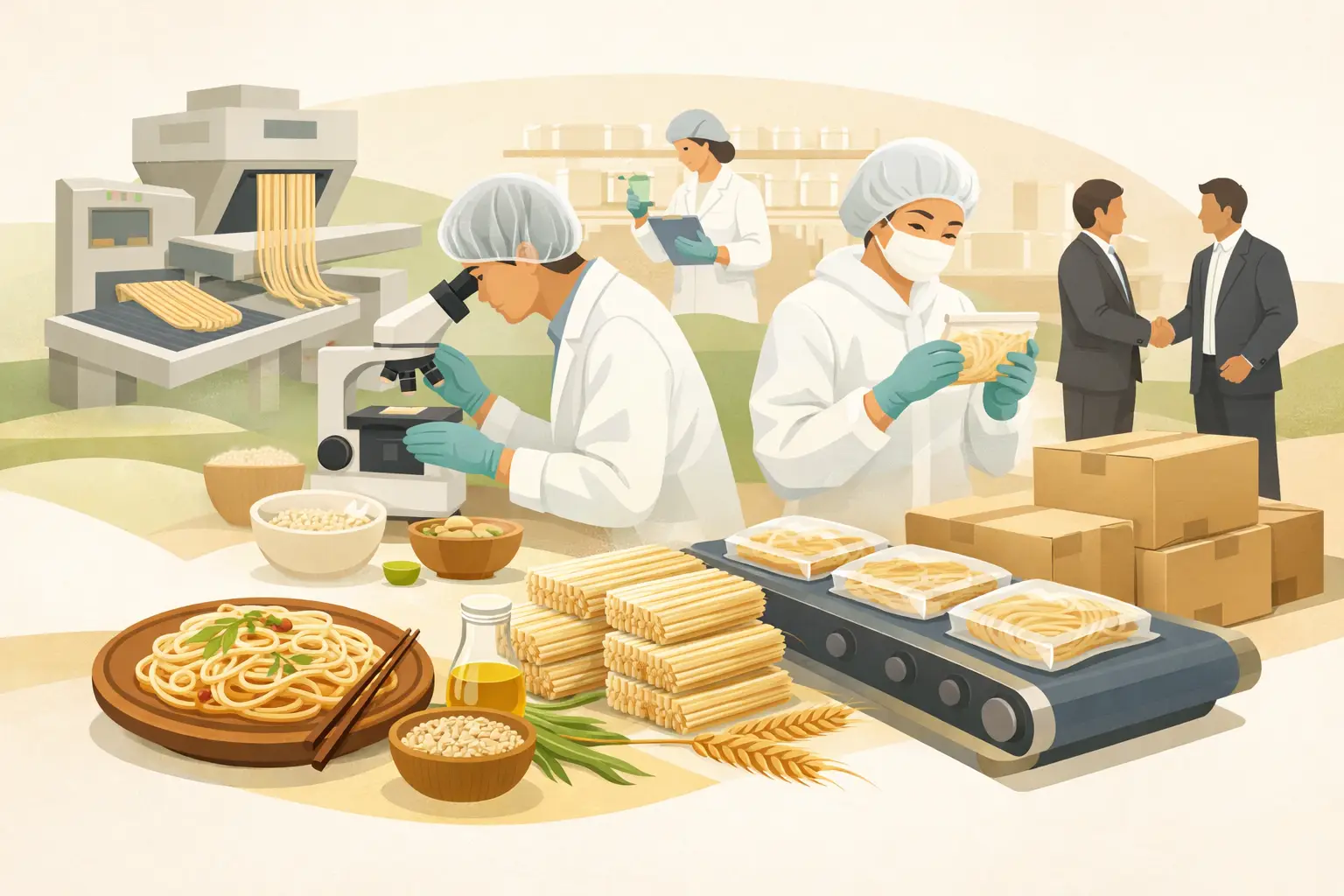
A franchise menu can only scale as far as its supply chain allows. That is why custom OEM noodle manufacturing is the future of food franchises - not as a trend term, but as a practical operating model for brands that need consistency, speed, and room to differentiate.
For franchise groups, noodles are no longer a simple commodity purchase. They are a product category tied directly to menu identity, kitchen efficiency, margin management, and customer expectations. When a brand expands across regions or markets, the noodle component has to perform the same way every time, while still allowing the business to shape texture, portioning, ingredients, and packaging around its concept. That is where custom OEM manufacturing becomes a strategic advantage rather than a back-end procurement decision.
Why custom OEM noodle manufacturing is the future of food franchises
Food franchises are under pressure from both sides. Customers expect more defined product quality and more variety, while operators need simpler execution, fewer sourcing risks, and stronger cost control. Standard off-the-shelf noodles can work for early-stage operations, but they often become a limitation once a concept grows beyond a small number of outlets.
A franchise brand usually needs more than just noodle supply. It needs a repeatable product system. That includes consistent dough formulation, stable noodle texture, suitable cooking performance, reliable pack specifications, and manufacturing standards that support broader distribution. Custom OEM production addresses those operational needs in a way generic supply rarely can.
It also gives franchise owners more control over what makes the brand recognizable. In a crowded market, slight differences in bite, thickness, drying method, or recipe profile can shape the eating experience in ways customers notice, even if they cannot describe them technically. Those details matter when a franchise is trying to protect its identity across multiple stores.
Brand control starts with product control
Many franchise operators spend heavily on store design, marketing, and menu engineering, yet still source a core food component that looks and performs much like everyone else’s. That creates a weak point in the brand model. If the noodle is central to the dish, it should be developed as part of the brand system, not treated as an interchangeable item.
Custom OEM manufacturing allows a franchise to define the noodle around its actual use case. A quick-service concept may need fast rehydration and stable hold time. A premium Asian dining brand may prioritize firmer texture and a more distinctive noodle profile. A retail-ready franchise extension may need portion-controlled packs and packaging formats suited for distribution.
This level of control helps reduce the gap between brand promise and delivered product. It also gives procurement and product teams a clearer standard to work against as the business expands.
Consistency matters more as store count grows
At one location, a skilled kitchen team can compensate for product variation. At twenty or fifty locations, that becomes much harder. Franchise systems depend on predictable preparation and predictable output. If noodle quality shifts from batch to batch, store teams absorb that problem through longer prep times, inconsistent plating, or customer complaints.
OEM manufacturing built around specification control can reduce that variability. The value is not just product quality in isolation. It is operational stability across the network.
Franchises need customization without operational complexity
There is a common misconception that customization creates complications. In reality, the right kind of customization can simplify operations. The key is to customize at the manufacturing stage so the stores do not have to improvise at the kitchen stage.
For example, noodle type, cut, texture, and portion size can be aligned with the franchise’s menu design before production begins. Packaging can also be matched to how the product will be handled by commissaries, central kitchens, distributors, or individual outlets. That reduces in-store adjustments and supports better training consistency.
This is one reason why custom OEM noodle manufacturing is the future of food franchises. It shifts product development work upstream, where it can be controlled properly, instead of leaving every store to manage variation downstream.
The right format depends on the franchise model
Not every franchise needs the same noodle solution. A foodservice group serving high-volume bowls may need durable noodles suited for repetitive preparation. A family-focused brand may want softer texture options or more child-friendly formats. A retail or export-driven franchise may need dry noodles that travel well and fit modern packaging requirements.
The point is not that one format is best. It is that the franchise should have a manufacturing partner capable of building the right format for the intended channel and growth plan.
Food safety and certification are business enablers
As franchise networks grow, supplier qualification becomes more demanding. Buyers are not just evaluating taste and price. They are assessing whether a manufacturing partner can support audits, documentation, product consistency, and market access requirements.
That is why certified food safety systems matter so much in OEM noodle manufacturing. Standards such as ISO 22000, HACCP, GMP, MeSTI, and Halal are not marketing add-ons for serious buyers. They support confidence in the production process and reduce friction when products move into organized retail, foodservice chains, or international distribution.
For franchise decision-makers, this has a direct commercial impact. A certified and disciplined manufacturing environment makes it easier to standardize sourcing, reduce quality disputes, and support expansion into channels that require stronger compliance discipline.
Better franchise economics come from fit, not just price
Buyers often begin with cost comparisons, which is understandable. But for franchises, the lower unit price is not always the better commercial decision if the product causes inconsistency, waste, menu limitations, or weak differentiation.
A custom OEM noodle program can improve economics in less obvious ways. Better portion control can support more predictable food cost. Improved cooking performance can reduce operational waste. A more suitable noodle format can make staff execution easier. Distinct product identity can also strengthen menu positioning in a crowded segment.
Of course, customization has trade-offs. Development takes coordination, and specification changes need careful management. A franchise that changes direction too often may create unnecessary complexity. The benefit is strongest when the brand has a clear product strategy and treats manufacturing as part of long-term system building.
Export readiness is becoming part of franchise planning
Many food franchises now think beyond a single domestic market from the start. Some plan regional expansion. Others extend into retail packs, private-label partnerships, or international foodservice channels. In those cases, export-ready manufacturing becomes highly relevant.
Dry noodle formats are especially practical for this. They can support wider distribution more efficiently than some fresh alternatives, while still allowing room for product differentiation through recipe, texture, and pack design. For brands targeting international growth, working with a manufacturer that understands export-oriented production requirements can reduce future disruption.
Malaysia has become an important manufacturing base for this type of supply, particularly for businesses seeking Asian noodle expertise combined with modern food production discipline. For buyers evaluating OEM partners, that combination matters because authenticity alone is not enough. Scalability and consistency are what make expansion possible.
Health-conscious positioning is easier to build into the product
Franchises are also responding to changing menu expectations. While claims must be handled carefully, there is clear demand in many markets for cleaner formulations, air-dried options, and product concepts tailored to specific consumer segments.
Custom OEM manufacturing gives brands more room to build those preferences into the noodle itself rather than relying only on front-end marketing language. That could mean selecting an air-dried format instead of a fried one, adjusting ingredient profiles, or creating child-friendly noodle concepts for family-oriented channels.
The advantage here is strategic flexibility. A franchise can adapt its product line to match market demand without abandoning its operational standards.
The best OEM partners help franchises build, not just buy
A dependable noodle manufacturer should do more than produce to order. The stronger model is partnership-based: understanding the intended market, clarifying the product brief, aligning specifications with use, and maintaining quality through scale.
This is where manufacturing experience becomes visible. It shows in how a supplier handles formulation discussions, production consistency, packaging practicality, and the realities of commercial rollout. For franchise businesses, that support can be just as valuable as the finished noodle itself.
Tehki Food operates in this space by supporting B2B buyers with OEM and ODM dry noodle development that balances customization, manufacturing discipline, and export readiness. That kind of capability is increasingly relevant for brands that want to build a more controlled and scalable noodle category.
Food franchises that treat noodles as a strategic product, not just a sourced ingredient, tend to be better positioned for consistent growth. The real opportunity is not simply to buy noodles more efficiently. It is to build a product system that travels well, performs reliably, and still feels like your brand wherever it is served.