
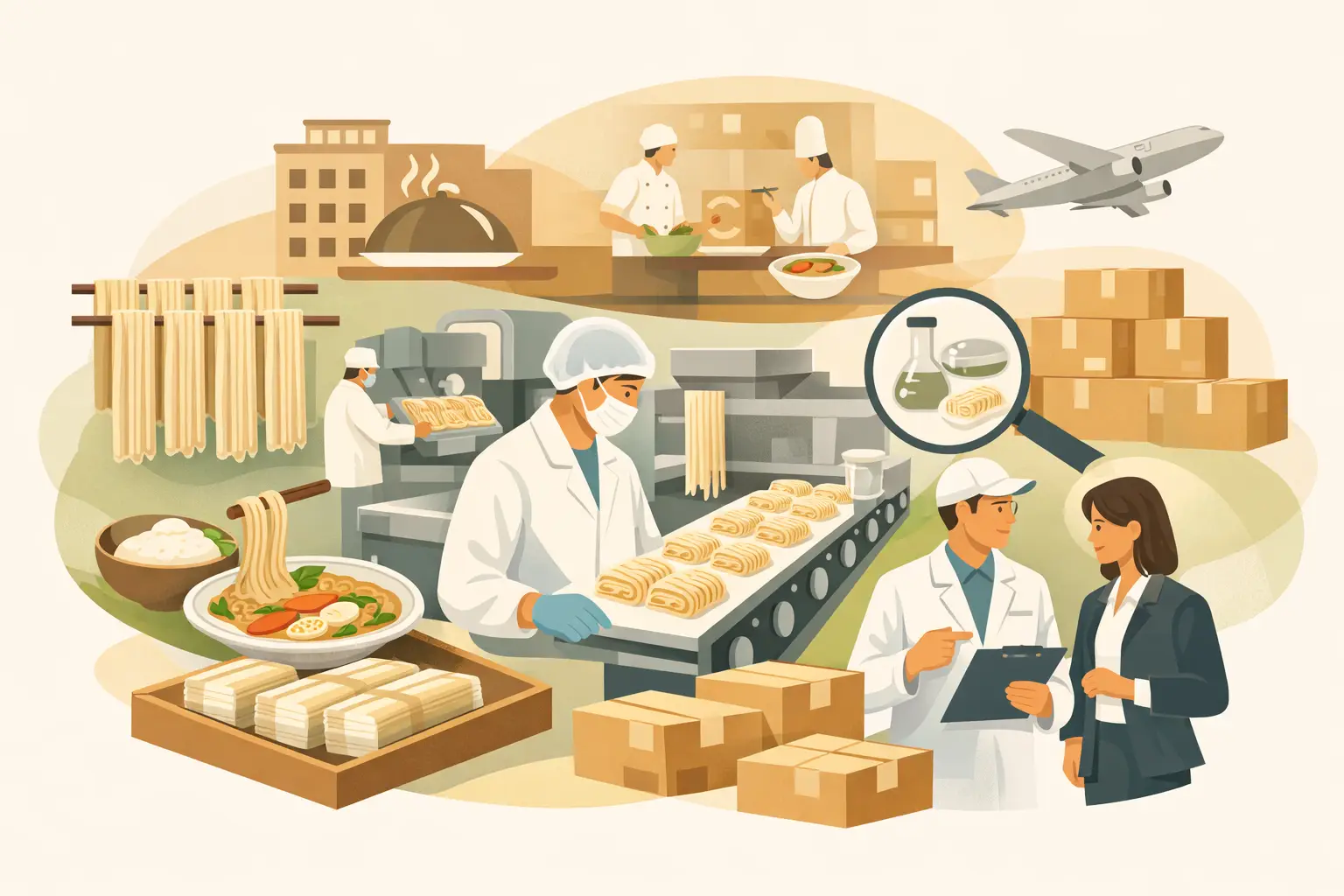
A noodle that performs well in a test kitchen can still fail during service. It may cook too fast in one outlet, break apart in holding, or lose its texture across multiple menu applications. That is exactly why from factory to kitchen: why HoReCa (Hotel, Restaurant, Catering) businesses rely on custom noodle manufacturing is more than a sourcing question. It is an operational decision that affects consistency, labor, food safety, menu planning, and brand reputation.
For hotels, restaurants, and catering operators, noodles are not just an ingredient. They are a repeat-use product that has to behave predictably under real service conditions. When the same noodle is used across soups, stir-fry formats, buffet stations, and set meals, small inconsistencies quickly become costly. Custom manufacturing helps reduce that risk by aligning the product to how the kitchen actually works.
From Factory to Kitchen: Why HoReCa Businesses Rely on Custom Noodle Manufacturing
In foodservice, standard products are not always practical. A noodle developed for general retail may not suit a central kitchen, a quick-service concept, or a high-volume catering operation. The issue is not simply taste. It is whether the noodle can hold texture, fit the portion model, work with the cooking method, and remain stable across repeated preparation.
Custom noodle manufacturing allows HoReCa buyers to specify the details that matter in day-to-day operations. That can include noodle type, thickness, width, bite, cooking response, ingredient profile, pack format, and portion sizing. These decisions directly affect kitchen speed, plating consistency, waste control, and menu reliability.
A supplier can ship noodles. A manufacturing partner helps shape a product around service requirements. That difference matters when menu execution has to be repeatable across locations, shifts, and staff skill levels.
Consistency Is a Kitchen Requirement, Not a Preference
In HoReCa, consistency is tied to cost control and customer experience. If one batch cooks softer than another, the kitchen adjusts on the fly. That usually means slower production, more supervision, and a greater chance of uneven dishes reaching the customer.
Custom manufacturing gives buyers more control over product specifications before production starts. Instead of adapting operations around an off-the-shelf noodle, operators can source a noodle designed for their intended use. If a restaurant needs a firmer texture for stir-fry, that can be built into development. If a catering business needs noodles that perform well in batch preparation, the manufacturing process can be adjusted accordingly.
This is especially relevant for businesses managing multiple outlets. A noodle with stable quality helps standardize recipes, training, and service output. That is valuable whether the business is running a private-label foodservice range, a chain restaurant menu, or an institutional catering program.
Product Fit Affects Labor Efficiency
Labor pressure is one of the most practical reasons foodservice buyers move toward customized products. When noodles are inconsistent, kitchen teams compensate manually through guesswork, extra monitoring, or corrective prep steps. Those hidden labor costs build over time.
A noodle designed for a specific cooking window or holding condition can simplify execution. It helps reduce variation between experienced and less experienced staff, which is important in fast-paced environments where training time is limited. The goal is not to remove skill from the kitchen. It is to make the product more dependable under pressure.
Customization Supports Menu Strategy
Many HoReCa businesses now need one core ingredient to serve several purposes. A noodle may appear in a signature soup, a lunch set, a delivery menu, and a banquet line. In that case, product selection affects menu engineering as much as culinary quality.
Custom noodle manufacturing gives buyers the ability to match products to concept needs. A premium hospitality brand may want a cleaner eating texture and a more refined presentation. A casual foodservice operator may prioritize speed, resilience, and portion control. A distributor serving mixed HoReCa accounts may need several formats under one private-label strategy.
This is where OEM and ODM capabilities become commercially useful. Instead of choosing only from existing stock formats, businesses can develop noodles around market positioning, customer preference, and operational requirements. That may involve air-dried formats for specific product positioning, child-friendly noodle concepts](https://tehkifood.com.my/show-product/infant-toddler) for family-oriented channels, fried noodles or tailored packaging for back-of-house handling.
Not every business needs full customization, and not every menu justifies it. For smaller programs, a well-selected standard format may be enough. But once volume grows or menu complexity increases, product fit becomes a stronger business case.
Quality Systems Matter Long Before Service Begins
The kitchen only sees the final product, but product reliability starts much earlier in the manufacturing chain. For B2B buyers, especially importers, foodservice groups, and brand owners, manufacturing discipline is part of the buying decision.
Custom noodle manufacturing works best when it is supported by clear quality systems, documented production controls, and recognized food safety practices. Certifications such as ISO 22000, HACCP, GMP, MeSTI, and Halal are not just credentials for a company profile. They help buyers evaluate whether a manufacturer has the structure to produce consistently and support commercial scale.
For HoReCa businesses, this reduces uncertainty. The product still needs proper storage, handling, and kitchen execution, but it begins with a stronger foundation. That matters even more when noodles are being sourced for private-label development or export distribution, where quality variation can create broader commercial issues.
Export Readiness and Multi-Market Use
For distributors and food companies serving international HoReCa channels, export readiness is part of product planning. Packaging, product stability, compliance documentation, and production consistency all affect whether a noodle range can move efficiently into different markets.
A manufacturer with experience supporting export-oriented noodle solutions can help buyers avoid gaps between development and commercial rollout. This is particularly relevant for importers and brand owners that need Asian noodle products tailored to local market demand while still being practical for foodservice use.
Malaysia has become an important manufacturing base for this kind of supply relationship because it combines established food production capability with strong familiarity in Asian noodle formats. For buyers looking at regional sourcing options, that can add practical value.
The Real Advantage Is Partnership, Not Just Production
The strongest HoReCa supply relationships are usually built around problem solving. Buyers do not only need a factory that can produce volume. They need a partner that understands how product choices affect procurement, operations, and brand execution.
That includes honest discussion about trade-offs. A thinner noodle may improve speed but reduce holding performance. A specific ingredient adjustment may help positioning but change texture. A more customized pack format may improve handling while increasing complexity elsewhere. Good manufacturing support means working through these choices with commercial realism.
This is where an experienced noodle manufacturer can add value beyond production output. Product development support, format flexibility, and a clear understanding of foodservice demands can shorten the gap between concept and workable product. Tehki Food operates in this space by helping B2B customers develop dry noodle products that are practical to manufacture, reliable to use, and aligned with real market needs.
Why HoReCa Buyers Keep Moving Toward Custom Solutions
The shift toward custom noodle manufacturing is not about making products more complicated. It is about making them more usable. When operators can source noodles that suit their menu, staff workflow, quality standards, and brand direction, the kitchen runs with fewer adjustments.
For some businesses, the need is straightforward: better texture consistency or more suitable portioning. For others, it is broader: private-label development, child-focused formats, cleaner product concepts, or a scalable noodle range that can serve several customer segments. The exact requirement depends on the business model, but the direction is consistent. Buyers want products built for purpose.
That is why from factory to kitchen: why HoReCa businesses rely on custom noodle manufacturing continues to matter across the sector. In foodservice, small product details have large operational effects. A dependable noodle program starts with understanding those details early, then manufacturing around them with discipline.
The better question for HoReCa buyers is not whether customization is necessary in every case. It is whether the current product is helping the kitchen perform as well as it should.