
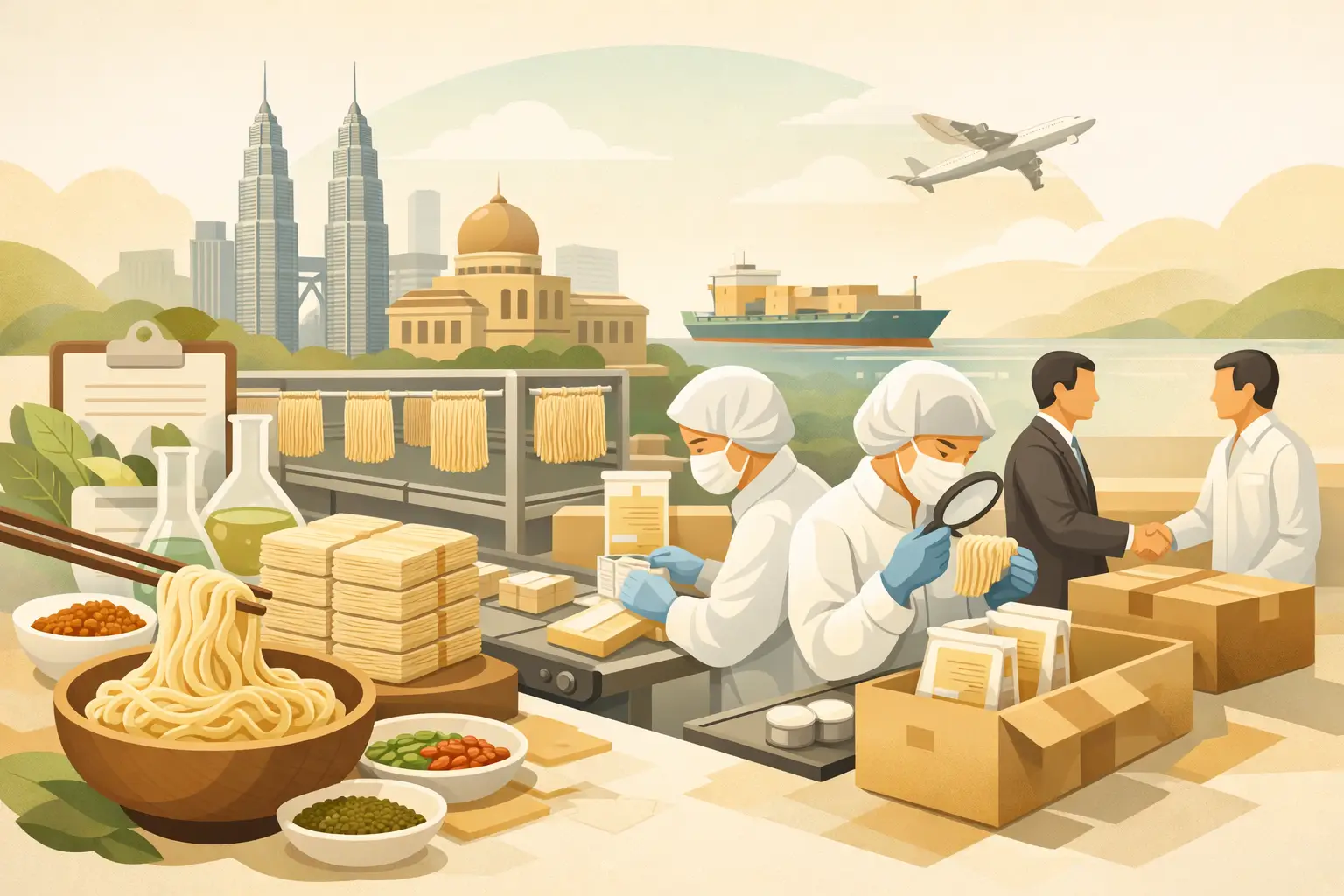
For importers, brand owners, and foodservice buyers, halal compliance is rarely a single checkbox. It affects ingredient sourcing, factory controls, documentation, export confidence, and ultimately whether a noodle product can scale across multiple markets. That is why Malaysia is a leading halal noodle manufacturing hub - not just because it produces noodles efficiently, but because it combines halal assurance with mature manufacturing capability.
For B2B buyers, that combination matters. A factory may offer competitive pricing or attractive product formats, but if halal requirements, quality systems, or export readiness are inconsistent, the commercial risk rises quickly. Malaysia stands out because it offers a stronger manufacturing environment for companies that need dependable halal dry noodle production at scale.
Why Malaysia is a leading halal noodle manufacturing hub for B2B buyers
Malaysia’s position comes from the way its food manufacturing ecosystem has developed. Halal standards are not treated as an afterthought added late in product development. In many facilities, they are built into ingredient approval, process control, plant management, and finished goods handling from the start.
That gives buyers a practical advantage. When a manufacturer already operates within structured halal and food safety systems, product development tends to move more smoothly. There are fewer surprises around raw material suitability, segregation practices, labeling requirements, and audit preparedness.
This is especially relevant in noodles, where the product itself may seem straightforward, but the manufacturing details are not. Flour selection, seasonings, processing aids, oil choice for fried formats, and packaging materials all need to align with product positioning and market requirements. In a well-managed Malaysian manufacturing setup, these decisions are typically handled with stronger process discipline.
Strong halal infrastructure supports commercial reliability
One reason buyers look to Malaysia is the strength of its halal manufacturing infrastructure. The value is not only in certification itself, but in the systems behind it. A capable halal noodle manufacturer needs traceability, approved supplier management, documented production controls, and a culture of compliance that can hold up under scrutiny.
That matters more in export business than many first-time buyers expect. If a private-label noodle range is being built for retail, distribution, or foodservice use, consistency becomes as important as product quality. The manufacturer has to deliver repeatable outcomes across batches, packaging runs, and market-specific requirements.
Malaysia’s advantage is that halal production often sits alongside broader food manufacturing disciplines such as HACCP, GMP, and ISO-based quality management. For buyers, this reduces the gap between halal compliance and overall manufacturing reliability. The result is a sourcing base that is often better prepared for formal vendor approval, retail supply expectations, and cross-border trade.
The country combines Asian noodle expertise with modern production
A halal noodle manufacturing hub also needs to be technically strong in noodles. Malaysia performs well here because it brings together regional noodle knowledge with modern production methods. That mix is useful for B2B customers who need products that are commercially practical, not just traditional in name.
Different markets want different outcomes. Some buyers need air-dried noodles with a lighter product profile. Others need fried noodles, customized textures, portion-controlled packs, or child-friendly formats for specific retail concepts. A manufacturer operating in a strong noodle production environment is better equipped to adjust formulation, process conditions, and packaging around those goals.
Malaysia has developed that flexibility over time. It is familiar with diverse Asian noodle styles and export-oriented product adaptation. This helps buyers who want products that are authentic enough for category credibility, but also stable, consistent, and suited to the channels they serve.
Export readiness is part of the equation
Being a leading hub is not only about making noodles well. It is also about supplying them reliably into regional and international markets. Malaysia has an established export manufacturing base, which makes it attractive to overseas buyers looking for halal noodle products under private label or house brand programs.
Export readiness shows up in everyday operational details. Packaging specifications, shipping carton configuration, document control, labeling support, and production consistency all affect whether a product launch runs smoothly. Buyers sourcing for multiple countries or sales channels generally need a manufacturing partner that understands those realities.
This is where Malaysia has a practical edge. The country is used to serving both domestic and international food businesses, which means many manufacturers are more familiar with the documentation and process discipline that export customers expect. That does not eliminate every sourcing challenge, but it lowers operational friction.
Why manufacturers in Malaysia appeal to OEM and ODM customers
For OEM and ODM buyers, the real value is not simply factory capacity. It is whether the manufacturer can turn a product brief into a repeatable commercial product. Malaysia is attractive because its better noodle manufacturers tend to offer more than basic contract packing. They can often support formulation adjustment, noodle format selection, texture targeting, portion planning, and packaging configuration.
That matters when buyers are building differentiated ranges rather than buying generic stock products. A distributor may need a halal dry noodle line tailored for regional retail. A foodservice operator may want a specific cut, cook performance, or pack size. A brand owner may need cleaner-label positioning or a child-focused concept that still works within manufacturing and sourcing constraints.
A mature manufacturing base makes those conversations more productive. Instead of treating customization as a disruption, experienced producers treat it as part of structured product development. That is one reason Malaysia continues to attract buyers looking for private-label growth, not just low-complexity supply.
Food safety and consistency help reduce sourcing risk
In B2B purchasing, product quality is only one part of the decision. Buyers also look at failure risk. Can the factory maintain standards across runs? Can it support audits? Can it control inputs and documentation well enough to protect the brand carrying the product?
Malaysia’s strength as a halal noodle manufacturing hub is closely tied to this risk question. Buyers often prefer sourcing environments where halal compliance exists alongside formal food safety and quality systems. That combination supports consistency, especially for dry noodle products where texture, breakage control, moisture management, and packaging integrity all affect market acceptance.
There is still variation from one manufacturer to another, and buyers should assess each supplier carefully. Not every factory has the same technical depth or customization capability. But as a sourcing base, Malaysia offers a stronger starting point because many serious manufacturers understand that certification, process control, and commercial discipline must work together.
Why Malaysia is a leading halal noodle manufacturing hub in a changing market
The market has changed. Buyers are not only looking for halal compliance. They are also looking for product flexibility, cleaner positioning, dependable quality systems, and formats that fit modern retail and foodservice needs. This includes demand for air-dried noodles, family-friendly concepts, and products developed for specific channels rather than broad, one-size-fits-all supply.
Malaysia is well positioned for this shift because its manufacturing sector can support both standardization and adaptation. That balance is valuable. Standardization helps protect consistency and efficiency. Adaptation helps buyers respond to category trends, customer preferences, and market-specific expectations.
For businesses evaluating long-term sourcing partners, this is often the deciding factor. The best manufacturing relationships are not built on price alone. They are built on whether a supplier can support brand growth, maintain production discipline, and adjust product development without creating unnecessary risk.
Manufacturers such as Tehki Food reflect why buyers continue to source from Malaysia: halal-certified production, export-oriented systems, and practical OEM and ODM noodle development under one roof. For businesses planning their next product range, the real opportunity is not simply finding a halal noodle supplier. It is choosing a manufacturing partner in the right sourcing environment, where compliance, customization, and consistency can support growth over time.